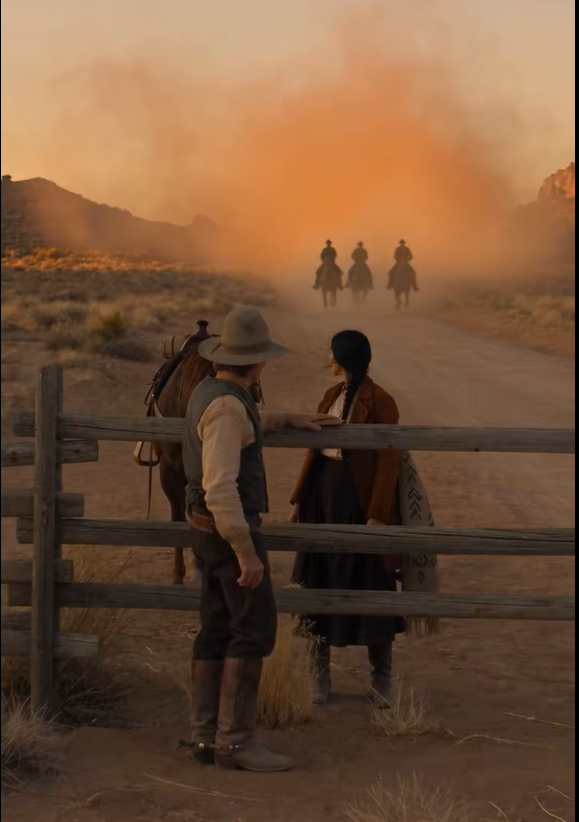
The mountain was supposed to be their grave.
Mara Higgins had stopped counting the days since the snow buried the trail beyond her cabin. Counting made the winter feel longer. Instead, she counted what remained: six pieces of firewood stacked beside the stove, two jars of dried beans, half a pouch of flour, and three bottles of medicine that would not last until spring.
Her children never saw the whole list. They saw their mother smile, stir thin soup, and promise that the cold would break soon. They saw the woman who had buried her husband but refused to let the mountain bury them too. Inside, Mara knew the truth was less forgiving.
The cabin groaned every night beneath the weight of ice. Wind slipped through cracks in the walls no cloth could fully cover. Her son Caleb had stopped asking when his father would return from the hunting trip he never came back from. Her daughter Lily had stopped asking for more food at supper.
That silence frightened Mara more than hunger.
She was tightening a strip of cloth around the handle of a broken bucket when the cabin door burst open and Caleb stumbled inside, snow covering his shoulders and his cheeks red from the cold.
“Ma! There’s a bear down by the frozen creek!”
For the first time in weeks, something like hope crossed the room.
Mara looked toward the empty shelves, then at her children. A bear meant meat. A bear meant a hide to block the wind and fat to burn in the lamps. It meant a chance. She grabbed her coat from the hook beside the door.
“Show me where you saw it.”
Caleb pulled on his boots again, his excitement fighting against the exhaustion that had settled into him. Mara wrapped Lily in an extra blanket and told her to stay by the stove, then stepped outside into a storm that seemed determined to erase every path they had ever walked.
The frozen creek was farther than Caleb remembered. Snow reached nearly to Mara’s knees in places, and each step demanded more strength than the last. The wind struck her face like handfuls of ice, but she kept moving because she could already imagine the warmth of a full meal in her children’s hands.
Then Caleb stopped. His mittened hand lifted toward the white landscape.
“There!”
A dark shape rested near the edge of the frozen creek, half-covered by snow.
Mara’s heart raced. She pushed forward, gripping the small knife at her belt. A bear could still be dangerous, even weakened by winter. She told Caleb to stay behind her, and she approached slowly. But the closer she came, the more something felt wrong. The shape was too narrow.
The legs were too long.
The arm that emerged from beneath the snow was shaped like a man’s arm. Mara stopped.
The wind moved around her, carrying a silence that felt heavier than the storm. She knelt and brushed snow away from the stranger’s face.
A man stared back at her with closed eyes and pale skin, frozen but not dead. His coat was expensive, made from materials Mara had only seen on travelers passing through town. This was not a miner lost in the mountains. This was someone who belonged to a world far beyond her small cabin.
Then she saw the shine near his chest. A gold pocket watch rested against his frozen coat. Mara reached toward it before she could stop herself. The watch was heavy in her hand.
It was more valuable than everything inside her cabin. More valuable than the small patch of land her husband had fought to keep. More valuable than the few belongings she had saved after his death. One decision. That was all it would take.
She could take the watch, leave the stranger, and no one would ever know. Her children could eat. Lily could have medicine. Caleb could have boots that did not leak water every time he stepped outside. Her fingers tightened around the gold. Then the stranger moved.
A faint sound escaped his throat. A breath. A man fighting to remain alive. Mara looked down at the watch, then at his face.
The mountain had given her a choice, and she hated that it had made the choice so simple. She placed the watch back inside his coat.
“Caleb,” she called.
Her son stepped closer, his eyes widening when he saw the stranger.
“He’s alive.”
Mara removed the rope she carried for gathering fallen branches and tied it beneath the man’s arms. Caleb watched as she leaned back and pulled, her boots sinking into the snow.
“Ma, we can’t carry him.”
“No.”
She pulled again, breathing hard.
“But we can’t leave him.”
Together they dragged the stranger through the storm.
Every step toward the cabin cost them strength they did not have. Snow covered their tracks almost immediately, as if the mountain itself wanted to hide what they had done. Caleb pushed from behind while Mara pulled from the front, refusing to look at how far the cabin still seemed.
By the time they reached the door, her arms shook too badly to untie the rope.
Inside, she laid the stranger near the fire and removed the ice-covered coat from his shoulders. Beneath the expensive clothing were signs of a long journey: torn fabric, bruises, and a wound near his side that had been hidden beneath layers of wool. Mara stared at him.
A stranger had entered their home carrying a secret she did not understand. And she had just given him the last chance her family had. For three days, the stranger remained unconscious.
Mara used precious medicine on him. She used blankets that should have been saved for the children. She fed him broth made from supplies she had measured carefully for weeks.
Caleb did not complain, but she noticed him staring at the empty shelves afterward.
On the second night, when the fire burned low, he finally asked the question she had been avoiding.
Discover more
Dictionaries & Encyclopedias
Weddings
TV Comedies
“Are we going to have enough?”
Mara sat beside him and looked at the flames.
“I don’t know.”
It was the first time she had ever admitted that to him.
The third night arrived with the storm still pressing against the cabin walls. Mara sat beside the stranger, replacing the cloth on his forehead, when his fingers suddenly moved. His eyes remained closed, but his lips parted. At first, she thought it was only a fevered whisper.
Then she heard the words.
“Find Higgins before Creed does.”
Mara froze. The cloth slipped from her hand. Higgins. Her family name.
The stranger had spoken the name her husband carried, the name written on every old document hidden in the cabin chest, the name that meant nothing to anyone in town except the family who had struggled to survive under it. She leaned closer.
“Who are you?”
The stranger did not answer. But his eyes opened.
They were tired, frightened eyes, and when he saw her face, the fear inside them became something else. Recognition.
He looked around the small cabin, at the children sleeping near the stove, at the walls patched by Mara’s own hands. Then he looked back at her.
“You’re a Higgins.”
Mara stood slowly.
“How do you know my name?”
The stranger tried to sit up but fell back with a sharp breath.
“Because I’ve spent years trying to find you.”
A sound outside cut through the cabin. Not the wind. Not a falling branch. Hooves. Several horses moving through the snow. The stranger’s expression changed immediately. The color left his face. Mara stepped toward the window and saw shapes moving beyond the darkness. Riders. The stranger grabbed her wrist with surprising strength.
“Listen to me.”
She looked down at his hand, then back at his face.
“Who are they?”
His voice dropped to a whisper.
“Creed.”
The name carried weight in the mountains. Everyone knew Silas Creed. He owned the trading post, controlled the nearest roads, and had enough money to make laws feel like suggestions. Mara pulled her hand away.
“Why would Silas Creed come here?”
The stranger stared at the frozen window.
“Because he knows I found the evidence.”
The riders stopped outside. Mara looked at the door.
The stranger reached inside his coat and touched the gold watch she had returned.
Then he looked at her with the seriousness of a man who knew the next few minutes could decide whether they lived or died.
“Mara Higgins,” he said, “the mountain beneath this cabin was never yours to lose.”