“Get lost! You filthy little beggar, you think you can touch my car?”
The shout cracked across the parking lot, sharp and cold. Ethan Cole was ten years old. His hand had just reached out, not quite touching the yellow supercar, when a huge hand slapped him hard across the face. His ears rang. His eyes blurred. He fell onto the concrete, his knee torn open, blood running down into his shoe, one cheek already swelling red. Before he could cry, the man bent down, grabbed his torn collar, yanked him up, and shoved him down again.
“Are you blind? You could work your whole life and never afford one wheel on this car, you piece of trash!”
That was Mr. Harrison, much younger then, in a black suit, holding a cup of coffee, standing beside the yellow car like it was part of his own body. Ethan’s mother, Sarah Cole, ran toward them. Before she could say a word, Harrison shoved her arm away. She fell to her knees on the concrete, her knees hitting hard. She could not stand back up, so she stayed there on her knees, her hands pressed together, crying and begging.
“Please, sir, I am begging you, he is only ten, he does not know any better, please let him go, I am begging you.”
Harrison did not let him go. He threw his hot coffee straight at her. The coffee splashed across her shirt and her hands. She stayed on her knees, afraid to wipe it off, bowing her head lower and lower. The whole parking lot burst out laughing. Someone pulled out a phone and started filming, shouting, “Get this, get this, look at these two beggars, they put on a great show!”
Ethan lay on the ground, one hand holding his swollen cheek, the other reaching for his mother. He saw her hands shaking, her shirt soaked with coffee, her knees bleeding just like his. In that moment, he stopped feeling the pain in his own face. All he felt was shame. Shame because he was too small and too poor to protect his own mother. He clenched his fists so hard that his nails dug into his skin and drew blood, and he did not even notice. He looked at the yellow car, then at the man, and he said one sentence to himself, quietly, but he remembered it for the rest of his life: “Someday, I will buy a car like that. And I will let kids like me sit in it. No one will ever slap them, and no one will ever throw coffee at their mothers again.”
Mr. Harrison stood there in his black suit, still holding his half-empty coffee cup, looking at the mother and son like they were trash that had dirtied his parking lot. He did not bend down to help anyone. He did not say sorry. He just waved his hand, like he was shooing away a fly. Ethan lay on the ground, one hand on his cheek, one hand reaching for his mother. He saw her trembling hands, her shirt wet with coffee, her knees bleeding like his. He did not feel the pain in his face anymore. He only felt shame, shame because he was too small and too poor to protect his mother. He clenched his fists until his nails cut into his skin. In his head, only one sentence kept repeating, louder than the laughter of the crowd, louder than Harrison’s shouting.
Seventeen years later, on another blazing hot afternoon, there was the same yellow car, and the same hand stopping in midair, afraid to touch it.
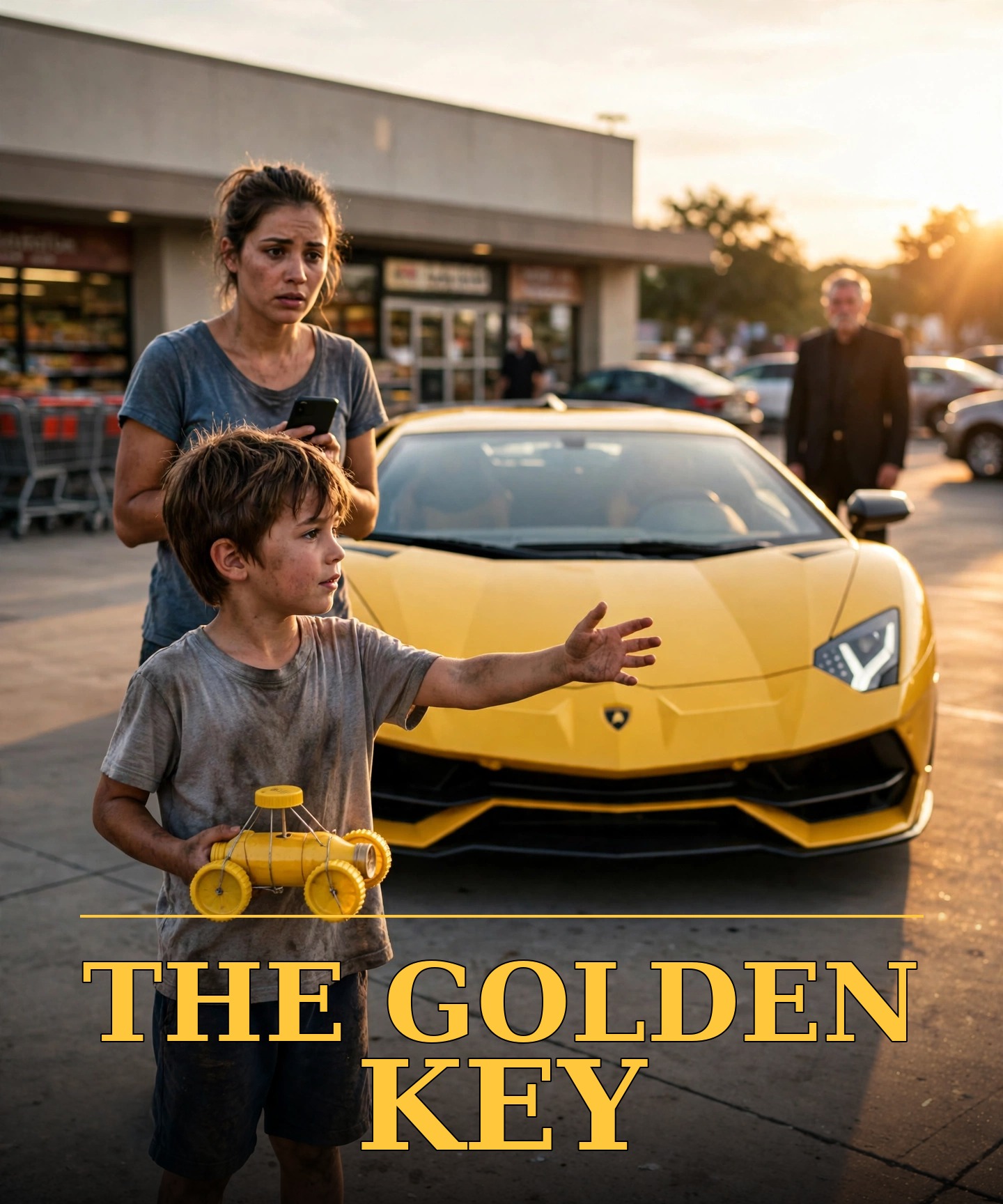
Ethan Cole, 27, drove his yellow sports car slowly through the grocery store parking lot in Houston, Texas. The summer heat shimmered up off the concrete. He had planned to stop for a few things and leave. He had not planned to stay long. His eyes stopped on the two people standing beside his car. A young mother, about 28, wore a faded shirt, old jeans, and worn-out sandals. Her phone screen was cracked in a long diagonal line, but she still held it high and tried to smile, even as sweat ran down her temples. Her little boy stood pressed against her, about seven years old, in a dirty T-shirt and old shorts, holding a small toy car in one hand. He had made it himself from bottle caps and a milk carton, painted yellow, held together with a rubber band. His eyes lit up when he looked at the yellow sports car. He raised his hand, his small fingers still dusty, and stopped about a hand’s width from the paint. He did not dare touch it.
Laura Bennett pulled her son a little closer, as if she wanted to shield him from the harsh sun. Ethan hit the brakes. The car stopped with a soft sound, but inside his chest, that sound felt very loud. He saw his own mother in this woman, the way she tried to smile even when she was tired, the way she held her phone high so her son could be happy, exactly like his mother used to do.
Across the parking lot, a man in a black suit stood beside a black sedan, holding a phone, looking in their direction. That was Mr. Harrison, 52 now. His hair had gone gray at the temples, his tall frame was still imposing, but his shoulders had started to stoop and his steps were no longer quick. He stood there with one hand in his pocket and one hand holding his phone, as if he was waiting for someone, or as if he was looking at something he never expected to see again.
Ethan turned off the engine. The sound of the motor died away, leaving only cicadas somewhere nearby and traffic humming in from the street. He opened the door and stepped out. His shoes touched the hot concrete, and the heat came up through the soles into his feet. The wind carried the smell of gasoline, hot pavement, sweat, dust, and coffee from a small shop nearby. Rough as it was, that little bottle-cap car was still the most beautiful car Milo owned.
Laura flinched when she saw him coming closer. She quickly pulled Milo behind her, clutching her phone tight in one hand and holding her son’s shoulder with the other. She thought he had come to chase them away. She thought he would yell at them, call them beggars, slap her boy the way another man had slapped Ethan all those years ago, throw water on them, and make them kneel and apologize. Her voice shook as she took a small step back. “I’m sorry, sir, we were just taking a quick picture, we will leave right now, I am sorry.” Milo peeked out from behind his mother, his eyes half scared and half curious, still clutching his bottle-cap car like it was something that could protect him. Laura looked at Ethan, then at the yellow car, then back at Ethan, her eyes full of fear and shame, as if she was apologizing for being poor, as if she was apologizing because her son had dared to look at a beautiful car.
Ethan did not answer right away. He looked at her, then at Milo, then he raised the gold key and opened the car door. The sound of the door opening was very soft, but to the mother and son, it sounded huge and clear in the middle of the noisy parking lot. He bent down, looked at Milo, smiled, and said his first words, slow and clear. “Come on, buddy. This car is yours today.” Milo froze. He did not dare move. He looked at his mother, as if to ask, “Can I really get in, Mom?” Laura froze too. She could not believe her ears. She looked at Ethan, at the key, at the car, then back at Ethan.
Ethan had remembered that afternoon so many times, every shout, every slap, every drop of hot coffee, every laugh from the crowd. He did not need to tell it again, because it was carved into him. What he remembered most was not the pain in his own face. It was his mother’s trembling hands, her shirt wet with coffee, her knees bleeding like his, and the promise he made to himself that day, small and quiet, but one he remembered for his whole life.
That night, his mother put ointment on his swollen cheek and his torn knee. Her hands were still red and burned from the hot coffee. She cried softly as she said, “Do not be angry at them. I only want you to grow up and never look down on poor people the way they looked down on us.” She spoke very slowly, afraid he would not hear her clearly, afraid he would forget what she said when he grew up. It was the last lesson she ever taught him about self-respect, and it was the lesson he carried with him all the years that followed, every time he wanted revenge, every time he wanted to become a man like Harrison. She did not teach him that he had to be rich. She only taught him never to look down on poor people, and that simple lesson turned out to be the hardest thing in his life.
The next morning, he went to school with one cheek still swollen and red. His classmates saw him and burst out laughing. “Hey, look, it is the little beggar who got slapped in the parking lot yesterday!” One of them pulled out a phone and played the video of Ethan and his mother being chased out of the parking lot for the whole class to see. Everyone laughed. Ethan sat in the back row and said nothing. He just opened his notebook and scribbled one crooked line on the last page: “I will buy that car. I swear.” His teacher saw it, but she only said, “All right, kids, stop teasing him,” and turned away. Ethan knew then that no one would stand up for him except himself and his mother. After school, he did not go straight home. He went to wash cars for hire at a lot near his house, seven dollars a car. Some days he washed ten cars and made seventy dollars, and he gave it all to his mother. Sometimes she held him and said, “Do not push yourself so hard. I do not need a car. I just need you to be healthy.” He shook his head. “Just wait for me, Mom.”
When he was fourteen, he was washing cars one day when he ran into Harrison again. Harrison walked in with a young woman, holding the keys to that same yellow car, walking with the same confident, arrogant stride as before. He saw Ethan and sneered. “Oh, look, it is the little beggar from back then. Now you wash cars for a living, huh? Wash it right, and do not get my car dirty.” Ethan gripped the washcloth in his hand until his nails dug into his palm. He wanted to lunge at him, to shout, to ask if he remembered that afternoon, if he remembered the woman who had knelt in front of him. But he remembered his mother’s words: “Do not be angry at them.” He bowed his head and kept washing the car, without saying a word. That night, he went home with his hands shaking. His mother asked, “What happened today?” He shook his head. “Nothing, Mom.” He did not tell her, because he did not want to hurt her all over again. It was not a fire of hate. It was the fire of a boy who had decided, “I will never bow my head to this man again.”
When he was sixteen, the biggest tragedy of his life happened. It was a July afternoon, the heat pouring down like fire. His mother was working the lunch shift at the diner, when she suddenly collapsed on the floor, still holding a tray in her hand. People rushed over, helped her up, and took her to the hospital. The doctor said she was exhausted, her heart was weak, her kidneys were failing, and she needed complete rest. She could not stop working. If she stopped, they would have no money for rent, for food, or for medicine. She asked the doctor to let her go home. She hid her medicine in a drawer, hid her pain behind a smile, and every night she still sewed Ethan’s old jacket, stitching it back together, thread by thread.
Six months later, on a cold winter morning, with fog covering the small street, Ethan came home from work and found his mother lying still in bed, her hand still clutching his old jacket. He called her name. No one answered. He shook her. Her hand was already cold. At the funeral, only a few neighbors came. There were no distant relatives, no close friends, just a small casket, a stick of incense, and a sixteen-year-old boy standing alone, holding his mother’s photo, unable to cry. He looked at her smile in the photo, and he remembered the question she used to ask him every night: “Are you hungry today, sweetheart?” That night, he sat down in the old parking lot, where he had once been slapped, where his mother had once knelt and apologized to a stranger. He looked at the yellow car in his imagination and whispered to his mother, “Mom, I am sorry. I did not buy you a car in time.” That night, he made a second promise to her. “Just wait for me, Mom. I will buy that car. I will never let anyone have to kneel and apologize like you did.”
The night after the funeral, Ethan went back to their small rented room, where everything was still exactly as it had been on the morning his mother left the house. The tray she had been holding that day had been returned, placed neatly on the table. His old jacket was still lying on the bed, where she had held it tight one last time. Ethan sat down on the floor and opened the old tin box where his mother kept her money. Inside were only old small bills, stacked neatly by value, and a small piece of paper folded in four. On the paper, in his mother’s clumsy handwriting, because she had only finished third grade, it said: “This money is saved for you. Do not spend it all at once. When you buy a car someday, if I cannot ride in it, you can drive your own kids in it.” Ethan read that note over and over, his tears falling and blurring the words. He counted the money in the box. It was a little over two hundred dollars, not enough to buy one wheel, but he held the box to his chest like a treasure. That night, he did not sleep. He sat by the window, looking out at the dark street, and for the first time he understood that his mother had not saved every dollar just to buy a car. She had saved it so he would believe that one day, he would have a car. The next morning, he took the tin box with him and put it in a drawer at the car wash, and every time he wanted to give up, he opened that drawer and looked at it, to remember that he was not only working for himself.
After his mother’s funeral, Ethan dropped out of school for good. He worked every odd job he could find: washing cars, delivering food, hauling boxes, working construction. Some nights he slept in the parking lot, using his jacket as a pillow and a cardboard box as a blanket. One night, a security guard kicked his cardboard box and shouted, “Get out of here, you homeless kid!” He was chased away again, just like when he was ten. But this time, there was no mother left to kneel and apologize for him. Every time he wanted to quit, he remembered the slap, the hot coffee, and his mother kneeling and begging.
When he was nineteen, he met a man who changed his life. That was Ray Morales, the owner of the car wash where Ethan worked for hire. Ray was about sixty, with gray hair, a short, stocky build, hands that always smelled of soap and motor oil, and a hoarse voice from years of smoking. He saw that Ethan worked hard, never complained, never stole, never slacked off, and he asked him, “Do you want to wash cars for other people for the rest of your life?” Ethan shook his head. “No, I want to open my own shop.” Ray laughed. “You have no money, no capital. How are you going to open it with what?” Ethan answered, “I have two hands, I have my health, and I am not afraid of hard work.” Ray looked at him for a long time, then said, “All right, I will lend you the money to open a shop. But you have to pay the interest on time. Do not run away. If you fail, you will work for me for the rest of your life to pay it back.” Ethan agreed right away, without a second thought. He borrowed the money and opened a small car wash with only two workers, including himself. Little by little, the shop got busy. One year later, he paid Ray back in full. Ray patted him on the shoulder and said, “You are different from other kids. Other kids get looked down on, and then they go look down on other people. You got looked down on, and you just got kinder to other people. You are going to be rich.”
Now, Ethan was standing at the open car door in the middle of the parking lot on a blazing hot afternoon, looking at Milo, waiting for the boy to step forward. The door was still open, the key was still in his hand, and the boy was still hiding behind his mother, clutching his little bottle-cap car. Laura was still standing there, holding her phone tight, looking at him with a mix of fear and hope, as if she did not know whether to trust him or pull her son away. Ethan did not rush him. He just opened the door wider, bent down to the boy’s eye level, smiled, and waited.
The first morning Ethan Cole opened his own car wash, the sky over Houston was still dark. He got up at four thirty, swept the lot himself, stacked the towels in neat piles, checked the soap, checked the hoses, checked the brushes. The shop had only two workers, him and Tommy, who was two years younger than Ethan and still clumsy with a buffer but willing to learn. Ethan did not hire anyone else, because he wanted to stand at the door himself, greet the first customer himself, and wash the first car of the day himself. He remembered what Ray Morales had told him. People do not just pay for a clean car. They pay to feel respected. Ethan had written that line on a small piece of paper and taped it behind the cash register, where he could see it every time he opened the till.
The morning at the car wash began with the sound of running water and wrung out towels. Ethan worked from six in the morning until midnight, washing every wheel, wiping every windshield, scrubbing every door frame. On hot days, sweat ran into his eyes until they stung, and he only wiped it away with his sleeve and kept working. On rainy days, rain blew into the lot, and he still stood under the awning and washed cars for customers who were waiting. He ate lunch from the taco truck near the shop, usually one plate of rice and beans, sometimes with an extra egg, sometimes only with vegetables. He never complained to anyone, because complaining did not bring in more customers.
He learned the names of his regulars, what kind of wash they liked, whether they wanted coffee or sweet tea while they waited. Mr. Thompson drove an old gray sedan. Every time he came in, he sat on a plastic chair, read an old newspaper, and waited until Ethan finished before he left. Ms. Rivera drove a small red car and often brought her little daughter, who loved to watch the white foam slide down to the pavement. Ethan kept a hot cup of tea ready for Mr. Thompson and a low chair ready for Ms. Rivera’s daughter. Customers came back to his shop not only because the cars were clean, but because they felt remembered. Slowly the shop got busy. Some days people had to wait in line. Some days Tommy had to write numbers in a notebook so no one got mixed up.
One year after he borrowed the money from Ray, Ethan paid it all back. That morning he carried a thick envelope to Ray’s old shop and placed it on the desk in front of him. Ray opened it, counted each bill, and looked at Ethan for a long time without saying anything. Ethan stood still, his hands clenched, his heart beating hard, because he was afraid Ray would say the cash was too much in small bills, or that he had paid too late. Ray finally laughed and slapped him hard on the shoulder. “You’re decent to people, people come back,” he said. It was a short sentence, but Ethan remembered it for the rest of his life. He did not brag to anyone about paying off the loan. He just went back to his shop, wiped down the tables, and worked like it was any other day.
He opened a second car wash at the end of the street, then a third near the big farmers market. He started buying used cars, the ones people sold cheap because the engine was weak, or the paint was scratched, or the owner could no longer afford the repairs. He checked each car himself, wrote every small problem in a notebook, took it to a mechanic he trusted for an oil change, new tires, and a fresh polish, and only then sold it to someone who needed it. He never lied about the condition of a car. If something was wrong, he said so. If he had fixed something, he wrote it down. If the price was fair, he explained why. Some customers were suspicious at first, but after they drove the car for a few months without trouble, they came back and brought their friends.
When Ethan was twenty five, he trusted Jake Turner the way he trusted himself. Jake was his closest business partner. They went to look at cars together, haggled with sellers together, and sat up late together adding up the books. Jake laughed a lot, said reassuring things, and promised they would open a much bigger dealership together. Ethan let Jake keep the cash in the safe, because he thought a close friend did not need to be watched. One morning he came to the shop early, as he always did, opened the safe to get money to pay the mechanic, and found it empty. Inside there was only a small folded note. On it, Jake had written in a hurry: “I’m sorry.” Ethan called Jake again and again. The phone rang and rang and then went silent. He drove to Jake’s apartment. The door was locked. Everything was gone.
He had lost nearly forty eight thousand dollars, all the money he had saved for years, money for a new shop, money to pay his workers. The second and third car washes had to close. Only the first one stayed open. Almost all of his workers left. Only Tommy stayed, saying he would work without pay for a few months until Ethan got back on his feet. That night Ethan sat alone in the shop, looking at the cars that had not been washed yet, looking at the wet towels still hanging on the line, looking at Ray’s old loan paper that he still kept in a drawer. He thought about his mother, Sarah Cole, and her question every evening: “Are you hungry today?” He wanted to cry, but no tears came. There was only a heavy feeling pressing on his chest, making it hard to breathe. He asked himself where he had gone wrong, and how he had trusted someone so fast.
A week later, when the shop had only a few regular customers left, an old customer placed a thick stack of cash on his desk. The man spoke quietly, as if he was afraid someone might hear. “I have a car that was in a flood,” he said. “You sell it for me like a good car, we split the profit. Nobody will know.” Ethan looked at the cash on the desk, looked at the customer, and then looked up at the photo of his mother on the wall. In the photo, his mother was smiling, holding a tray, her hair tied back neatly, her shirt faded but clean. He remembered the night she put medicine on his swollen cheek and his scraped knee. He remembered her burned hand, shaking as she worked. He remembered what she had said: “When you grow up, never look down on poor people the way they looked down on us.” He understood that if he took this money today, he would become a man like Mr. Harrison, a man who made money by cheating other people.
He pushed the stack of cash back across the desk and said slowly, “I don’t do that.” The customer looked at him in surprise, gave an awkward laugh, took the money, and left without another word. Ethan sat alone again, his hands still shaking, because he knew he had just turned down the fastest way to get his lost money back. But his chest felt a little lighter, because he knew his mother, if she were still alive, would not have wanted him to do it. He took a towel, stood up, and kept washing the car that was waiting outside, even though his arms were tired and his eyes burned from lack of sleep. He said to himself, “You fall down here, you get up here.”
He started over from the beginning. By day he washed cars at the small shop that was left. By night he delivered food around Houston to earn extra money. On rainy nights he wore a thin rain jacket and rode through flooded streets, holding the delivery bag tight against his body, his eyes struggling to see through the headlights. Some nights he finished a delivery close to two in the morning, got back to his apartment, and fell asleep before he could even change out of his wet clothes. He did not tell anyone how hard it was. He did not borrow more money from Ray. He did not ask anyone for help, because he wanted to stand up again with his own two hands.
Two years later, he paid off his debts, reopened the second car wash, and then reopened the third. He bought used cars again, fixed them, and sold them, but this time he was more careful, kept clearer records, and never let one person hold all the money again. He hired two more young workers and taught them how to wash a car, how to greet a customer, how to keep the books, and how to tell the truth about a car. He still ate cheap lunches, still wore cheap shirts, still rode an old motorcycle, and saved every dollar he earned. When he was twenty seven, he bought his first yellow supercar, a yellow Lamborghini exactly like the one Mr. Harrison had owned. He held the key in his hand and stood in front of the car, but he could not smile, because the person he wanted to take for a ride in that car most was no longer alive.
He drove the car all over the city, but inside he felt empty. He had money, he had a car, he had a house, but every night he came home and ate alone. He still remembered his mother’s question. He still remembered the smell of her cooking and the sound of her voice waking him up for school every morning. He understood that he had kept his promise about the car, but he had not kept the most important promise, to let his mother sit in that car. From that day on, he made a promise to himself. If one day he met a mother and a child like him and his mother used to be, he would not just stand and watch. He would do for them what his mother had not lived long enough to see.
That afternoon, in the parking lot, that promise suddenly became real. Milo Bennett climbed into the driver’s seat, one small step at a time. His hands wrapped around the steering wheel. His eyes opened wide. His mouth broke into a loud laugh. He was seven years old, his shirt was dirty, his shorts were old, but his eyes shone when he looked at the yellow car. At first he had not dared to touch it. He had only stood and looked, afraid he might make it dirty. Now that he was sitting in it, he looked at the steering wheel, looked at the dashboard, looked at the rearview mirror, and then looked at Ethan, as if to ask, “Am I really allowed to sit here?” Ethan smiled, leaned in through the window, and showed him how to hold the wheel, how to honk the horn, and how to turn on the lights. Milo did what he was told, laughing without stopping, and his laughter rang across the whole parking lot.
Milo honked the horn once. The sound startled him, and then he laughed even louder. He turned on the lights. The yellow light fell across his face and made his eyes shine. He turned the wheel to the left, then to the right, as if he were really driving down the road. Ethan stood beside the car, one hand resting lightly on the door, watching the boy. Inside, Ethan felt as if he was seeing himself at ten years old again. Now this boy was allowed to sit, allowed to touch, allowed to laugh out loud without fear of being slapped or chased away.
Laura Bennett stood behind the car, both hands covering her mouth, unable to believe her eyes. She was not crying because she was happy in a simple way. She was crying because she remembered all the days when she and her son had only dared to look at other people’s cars from far away, never daring to come close. She remembered the afternoons when they walked through the parking lot and Milo pointed at beautiful cars and asked when he would get to sit in one. She stood there, tears running down onto her hands, but her eyes were smiling along with her son.
Ethan took out his phone and filmed the moment for them. He filmed Milo laughing in the car, filmed Laura covering her mouth in wonder, filmed the whole yellow car sitting in the sun. He filmed it so that later the boy could watch it again and remember that there had been a day when his dream came true. He filmed slowly and carefully, not in a rush, because he knew this moment would not come back a second time. When he finished, he gave the phone back to Laura and said, “Keep it. So he can watch it later.” Laura took the phone with both hands, as if it were something precious. Her hands were still shaking. The screen was already cracked in a long line, but she did not care.
Milo placed his bottle cap toy car on the dashboard of the real car. The little car was tiny, its paint was chipped, its wheels were two red bottle caps, its body was a cut up milk carton, but Milo held it like a treasure. He said to Ethan in a quiet voice, “This is my car. I made it myself. Today my car gets to sit next to a real car.” Ethan looked at the little car, then at Milo, and felt something warm rise in his chest. He did not laugh at the boy. He only nodded and said, “Your car is beautiful. Keep it safe.” Milo nodded hard, his eyes bright, as if someone had finally recognized his dream.
Laura told Ethan briefly about their life, her voice low, as if she was afraid of bothering him. She said she cleaned houses and worked at a farmers market, getting up at four in the morning to clean up produce stalls. Her hands were cold from water, her back hurt from bending down to pick up fallen vegetables, but she worked fast, because if she worked slowly, the stall owner would hire someone else the next day. By seven she ran back to their small rented apartment, cooked one pack of noodles to split between the two of them, and took Milo to school. Her husband had left when Milo was little and had left behind nothing but a small apartment and months of unpaid rent. She said there was a time when Milo asked her, “Mom, when will I get to sit in a nice car like the other kids?” She had not been able to answer. She had only held him and said, “Be good, one day you will.”
That morning, before they came to the parking lot, Milo had spent a whole afternoon making his toy car. He used two red bottle caps, a milk carton, and a rubber band he had found at the market. His hands were sticky with glue, but when he finished, he held it up to show his mother, his eyes shining. “Mom, my car is yellow like a real car,” he said. Laura looked at the little car. She did not have the heart to say that it did not look like a real car at all. She only patted his head and said, “It is beautiful. Keep it safe.” That night, Milo put the bottle cap car on his pillow and dreamed that he was driving it all over the city, while Laura sat beside him, mending his pants under a yellow lamp, wondering when her son would ever get to sit in a real car, even once.
Ethan listened to Laura without interrupting, standing still, his hand still resting on the car door. He remembered his own mother, remembered how she also did odd jobs, also left early and came home late, also could not answer his questions about cars, money, or the future. He understood how Laura felt, because he had lived that feeling himself. He looked at Milo sitting in the car and at Laura standing behind it, and then he took the car keys out and placed them in Laura’s hand. Laura pulled her hand back, as if she had been shocked. She shook her head again and again and said, “No, no, sir, we cannot take this, this is too expensive, we cannot afford to keep it.” Her hands were still shaking, her eyes moved from the keys to Ethan and back again, as if she could not believe her ears.
Ethan held her hand closed around the keys so she could not give them back, and said slowly, one word at a time, “I am not just giving it away. I own the dealership down the street. You can work there as a receptionist. The pay covers living costs. Insurance is already paid for two years. I will do the title transfer at the DMV tomorrow. You can sell the car anytime if you want. That is your choice.” Laura listened and could not say anything more. She only looked at him, looked at the keys, looked at her son laughing in the car, and tears ran down her face again. She understood that Ethan was not only giving her a car. He was giving her a job, a way to raise her son, and a chance to never have to kneel and beg anyone again.
Ethan bent down and looked at Milo. His eyes met the boy’s eyes, and he said clearly, “From today, no one gets to tell you that you do not deserve to sit in this car.”
Laura hugged Milo first. She pulled him close and held him tight, as if she could keep that moment from slipping away. Then she turned and hugged Ethan. She pressed her face against his chest and cried into his white shirt. Her shoulders shook. She did not try to stop the tears. Milo wrapped his arms around Ethan too. He pressed his cheek against Ethan’s stomach and held on with both hands. The three of them stood together in the parking lot beside the yellow car as the afternoon light faded.
The heat still rose from the concrete in Houston. It shimmered near the ground and made the far edge of the lot look soft and far away. A truck passed on the street beyond the lot, and its tires made a low sound on the asphalt. Somewhere nearby, a car door closed. The yellow paint on Ethan’s car caught the last strong light and threw it back in a bright, clean shine. The shadows of the three of them stretched long across the concrete and joined into one long shape. Laura could hear her own heartbeat. She could hear Milo breathing against her side. She had never hugged a stranger like this. She had never been hugged back by a stranger like this.
Ethan put one hand gently on her back. He did not squeeze too hard. He did not rush her. His other hand rested on Milo’s shoulder and kept the boy close. Milo looked up at Ethan, then at his mother. Tears were still in the corners of his eyes, but he was smiling. He did not understand everything that was happening. He understood one thing very clearly. Today was different from every other day. Today he had sat in the yellow car he had only dared to look at from far away. Today his mother had cried, but not because she was sad. Today a man had opened a car door for him and told him he was worthy of it.
Across the parking lot, Mr. Harrison still stood there. He had lowered his phone. He was no longer holding it up to record or take a picture. He just stood and watched. His eyes moved from Milo in the car, to Ethan, and then to the yellow car he had once owned. That yellow car now sat in the sun with its door wide open, and the driver’s seat still held a little of Milo’s warmth. Harrison looked at it for a long time. He remembered the afternoon seventeen years ago, when a ten year old boy had reached out to touch his car. He remembered his own hand. He remembered the slap. He remembered the boy’s mother kneeling and begging. Those images had been far away in his mind for a long time. He had tried to forget them. He had tried to tell himself that it was only a small moment in a long day. Now, as he watched Ethan stand in the middle of the lot, as he watched Milo hug Ethan, those images came back sharp and clear. His hand tightened around his phone, then slowly let go. His fingers trembled a little. He did not step forward. He did not say he was sorry. He just stood still, as if his feet had been fixed to the hot concrete.
Ethan had seen him. He had seen Harrison from the moment he stepped out of his car. He had known him in the first second, even after seventeen years. Harrison’s hair was grayer at the sides. His shoulders had dropped a little. His face had more lines. But his eyes, his stance, the black car beside him, Ethan could not forget those. Ethan did not walk toward him. He did not shout. He did not hit him. He did not ask if Harrison remembered that afternoon. He just held Milo’s hand a little tighter. Milo’s hand was small and warm in his. Ethan felt that warmth, and he knew he did not need to walk over to Harrison. What he was doing here, opening the car door for Milo, putting the keys into Laura’s hand, was already a clear enough answer. He stood still, holding the mother and son, and let Harrison look, and remember, and face himself.
Laura lifted her head and looked up at Ethan. Her voice shook when she spoke. It was barely loud enough for Ethan to hear. “Why would you do this for us?” She looked at him with red eyes, her hand still holding the car key tight. She did not understand why a stranger would give her family a car that cost so much. She was afraid this was only a dream. She was afraid that when she woke up, the car would be gone. She was afraid someone would ask for the key back. She was afraid she had taken something too big, something she did not deserve.
Ethan looked at the car, then toward Harrison, and said only one sentence. “Because my mom never got to sit in this car.” His voice was low and slow. It was not loud. It was not choked with tears. He spoke as if he were talking to himself, and to his mother, and to the ten year old boy he had once been. Laura heard that sentence and did not ask another question. She understood that behind those few words there was a long story she did not yet know. She nodded gently. Tears ran down her face again. She rested her head against Ethan’s chest for a moment longer, then slowly let go.
Milo laughed and pressed the horn again. The sound rang out across the parking lot, bright and happy. He turned to Ethan and held up his bottle-cap toy car. The little car was old. Its paint had chipped. One wheel tilted a little to the side. It was the only toy Milo owned, the one he always kept in his pocket. He set it carefully in the middle of the dashboard of the yellow car, straight and neat. “Let the little car sit with the big car,” he said. Ethan looked at the little car, then at Milo, and nodded. He did not take the little car down. He left it there, like a memory, like a reminder that big dreams start from very small things. Laura looked at what her son had done and laughed through her tears. She wiped her eyes with her hand, then looked at the yellow car again. She still could not believe that from today, this car would belong to her and Milo.
Ethan took a business card from his shirt pocket and gave it to Laura. The card had the name of his dealership at the end of the street, with the address and phone number printed in clear black letters. He spoke slowly and clearly, so Laura could hear every word. “Come to my dealership tomorrow at nine in the morning. Bring your ID. I have the paperwork ready. You do not need to bring money.” Laura took the card with a trembling hand. She read the address again and again, as if she were afraid she might forget it. Ethan added, “Tonight, keep the key safe. Lock the car. Do not leave the key in the car. Take Milo home early and get some rest. You have an early morning tomorrow.” Laura nodded. She promised she would be there on time. She looked at Ethan and wanted to say thank you, but her throat tightened and the words would not come out. Ethan smiled a little and said, “You do not need to thank me. Just be there on time.”
Then Ethan opened the car door for Laura. Laura sat in the driver’s seat and put her hands on the steering wheel. Her breathing became quick. She had never driven a car this beautiful. She had driven an old motorcycle to work. She had ridden in the back seat of other people’s cars. But she had never sat behind the wheel of a sports car. Milo sat in the passenger seat and buckled his seat belt. He still held his bottle-cap car with both hands. Ethan stood outside, leaned down, and showed Laura how to start the car, how to shift into gear, how to brake. “Drive slow,” he said. “Just go around the parking lot once. I will walk beside you.” Laura nodded and started the car. The engine sounded smooth and strong. She eased off the brake, and the car rolled slowly across the concrete. Milo laughed loudly and waved his hand at Ethan. Ethan walked beside the car, his hand resting lightly on the door, as if to keep the mother and son safe. They went around once, then again. Laura drove slowly, but her hands grew steadier with each turn. She cried as she drove, tears running down her cheeks, but she was smiling. For the first time in many years, she drove without worrying about gas money, or rent, or food for tomorrow. She only worried about driving slowly and carefully, so this moment would last a little longer.
Across the lot, Harrison took one step away, then stopped. He had planned to turn his back, walk to his black car, open the door, and drive away from this parking lot as if nothing had happened. But his feet would not lift. He stood still and turned his head to look at Ethan one more time. In his mind, the ten year old boy from seventeen years ago appeared very clearly. The boy had fallen on the concrete, his knee scraped, his cheek red and swollen, his hand covering his face, his eyes looking up in fear. Beside the boy, his mother had knelt down, her hands pressed together, her shirt wet with coffee, her knee bleeding. Harrison remembered himself in that moment. He remembered his own voice. He remembered the contempt in his own eyes. He squeezed his phone once more, then let go. He did not step forward. He did not apologize. But he did not leave right away either. He stood there for a long time, watching the yellow car move slowly around the lot, watching Milo laugh, watching Ethan walk beside it.
When the afternoon light was almost gone, Laura stopped the car in its old spot. She turned off the engine, stepped out, and hugged Milo. Ethan closed the car door and gave Laura a tissue to wipe her tears. “See you tomorrow,” he said. Laura nodded. She took Milo’s hand and walked toward the gate of the parking lot. Milo turned back many times, waving at Ethan, waving at the yellow car. Ethan stood and watched them until their figures disappeared behind the trees. Then he looked back across the lot. Harrison was no longer standing there. The black car had also gone, leaving only an empty space on the concrete. Ethan did not know when Harrison had left, or where he had gone. He did not chase him. He just stood still for a moment, took a deep breath, opened the door of his yellow car, and sat in the driver’s seat. He saw the little bottle-cap car still sitting on the dashboard. He smiled a little, then drove home.
That evening, Harrison drove his black car home alone, down streets he had driven many times but had never felt this long. His house was large, the lights were on, but it was as quiet as Ethan’s house. The only difference was that there were no pictures of anyone on his walls. He took off his suit jacket, hung it up, sat down in a chair, and still held his phone, though the screen had gone dark a long time ago. He thought about the afternoon seventeen years ago. He thought about the ten year old boy who had fallen on the concrete. He thought about the mother who had knelt and begged. He had once thought that day was just a normal afternoon, that a poor boy had dirtied his car, and that he had a right to be angry. But tonight, after seeing Ethan open the car door for Milo, after seeing Laura hold her son and cry, he suddenly remembered himself as a boy, when his own father had been thrown out of a parking lot, when he had stood and watched a beautiful car from far away and had not dared to touch it. He opened the drawer of his desk and took out an old rusted key. It was the key to the first work truck his father had ever driven for hire. He held the key tight in his hand and sat still for a long time. He did not turn on the light. He did not eat dinner. He only looked out the window, where the yellow streetlight fell on the empty road. He did not know what he would do tomorrow, whether he would go back to that parking lot or not, whether he would say he was sorry or not, but for the first time in seventeen years, he no longer felt sure he had been right.
That evening, Ethan went home alone. His house was large and quiet. The lights were on, but there was no sound of another person. He took off his white shirt, hung it up, and set the yellow car key on the table. On the table there was also an old photo of his mother, Sarah Cole. In the photo, she was smiling, holding a tray, standing in front of the diner where she had worked. Ethan sat down and looked at the photo for a long time. He remembered what his mother had taught him all those years ago. He remembered the night she had put medicine on his swollen cheek and scraped knee. He remembered her hand, still red from the hot coffee burn. He opened a drawer and took out an old key. It was the key to the first car wash he had opened with a loan from Ray Morales. He set the old key beside the yellow car key and looked at the two keys lying side by side. One key had opened a small shop. One key had opened a large car. But both had started with a ten year old boy who had been slapped in a parking lot. Ethan sat like that for a long time, until the clock struck midnight. He stood up and went to his bedroom, but he did not fall asleep right away. He lay on his bed with his eyes open, looking up at the ceiling, thinking about Laura and Milo, thinking about tomorrow, thinking about Harrison. He wondered what Harrison would do tomorrow. He wondered if Laura would come to the dealership on time. He wondered what Milo would tell his friends at school about today. Those questions kept turning in his mind, with no answers, but he did not feel worried. He only felt lighter than he had felt on other evenings.
The next morning, the sky was clear and the sun was soft. Laura arrived at Ethan’s dealership at nine o’clock sharp. She wore her cleanest shirt. Her hair was brushed neat. She held Milo’s hand. Milo wore a new shirt and still held his bottle-cap car. The boy looked at the large dealership, at the cars parked in neat rows, his eyes wide with curiosity. Laura walked into the dealership with her heart beating fast. But the staff smiled and greeted her, and led her to Ethan’s office. Ethan was already waiting there. On his desk were the papers, a pen, and a glass of water. He stood up to greet Laura and Milo and invited them to sit down. “You are right on time,” he said. Laura let out a breath she had been holding. She sat down, still holding Milo’s hand tight. Ethan began to help her fill out the forms, explaining each part slowly so she could understand it. Milo sat beside her, watching Ethan work, and sometimes looking out the window at the yellow car parked in the yard.
That morning, before they came to Ethan’s dealership, Milo had woken up earlier than usual. He wore the newest shirt his mother had washed clean the night before. He looked in the mirror many times, then put his bottle-cap car in his shirt pocket and patted the pocket gently, as if to make sure it was still there. On the way there, he asked his mother many questions. He asked if he would get to sit in the yellow car again today. He asked if Mr. Ethan would remember his name. He asked if he would get to tell his friends about it tomorrow. Laura only smiled, held his hand tighter, and said, “Tell it very slowly, or your friends will not believe you.” Milo nodded, his eyes bright, as if he had already prepared a long story in his head, a story he would tell again and again until everyone believed that one day, he had really sat in that yellow car.
In another part of the city, Harrison still had not shown up. He had not called Ethan. He had not come to the dealership. He had not sent a message. No one knew where he was, what he was thinking, or what he planned to do next. That question stayed open, just like the question of whether Laura would take the receptionist job at the dealership, and just like the question of what Milo would tell his friends at school when they asked him about the yellow car. But Milo knew one thing. From today, when someone asks him what he wants to be when he grows up, he will not look down. He will look up and say he wants to be like Ethan.