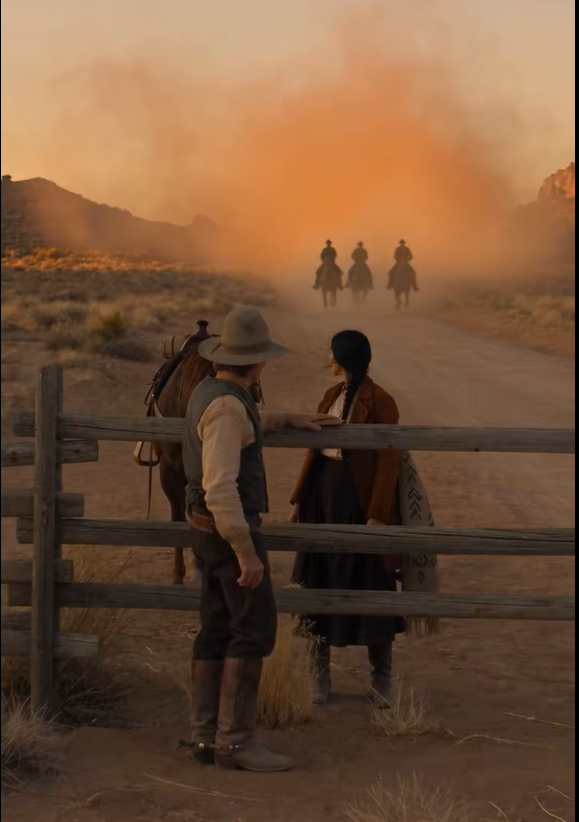

The Bride Who Came Out of the Dust. By Dawn, Daniel Harper Would Learn She Had Been Promised More Than His Name.
The first thing Daniel Harper noticed about the woman riding toward his ranch was that she carried no bridal trunk.
The second was the rifle strapped across her saddle.
And the third was that she was looking at him as though she already knew exactly who he was.
The Arizona Territory burned beneath the last light of evening.
Heat still rose from the cracked earth in wavering curtains, though the sun had begun sinking behind the distant purple mountains. Dust hung above the road like smoke. Somewhere in the mesquite, a cicada screamed until the sound became almost unbearable.
Daniel stood beside the weathered fence of Harper Ranch, one hand gripping the top rail.
He had been waiting since noon.
Waiting for the stagecoach.
Waiting for Miss Celia Wren.
Waiting, if he were willing to admit it, for the woman who was supposed to save him.
Six months earlier Daniel would have laughed at any man desperate enough to agree to marry a woman he had never met.
Now his cattle herd had been cut almost in half by drought.
The bank note on the ranch matured in four days.
Three wells had gone dry.
His foreman had left for California.
And Amos Creed, the most powerful lender in the county, had made Daniel an offer that felt less like salvation than a rope lowered into a grave.
Marry Celia Wren, Creed’s distant ward.
Celia would bring a settlement of six thousand dollars.
Daniel would use the money to clear his mortgage.
In return, Creed would receive an easement through Harper land for a new cattle road.
At least, that was what Daniel had been told.
Six thousand dollars was more than enough to save the ranch his father had spent thirty years building.
And then the letters had begun.
Discover more
Family & Relationships
Social Sciences
Farms & Ranches
Celia’s letters.
At first they had been careful.
Polite.
Almost formal.
Then something changed.
She wrote about books.
About loneliness.
About the foolish things people did when they were afraid.
She confessed that she hated roses because everyone expected women to love them.
Daniel told her he hated Sunday sermons because they always seemed twice as long when he was hungry.
She wrote that she had once ridden twenty miles in the rain just to see a river flood.
He told her that his mother used to stand outside during thunderstorms because she said lightning reminded human beings how small they were.
By the fifth month, Daniel had stopped thinking of Celia’s six thousand dollars.
He had started waiting for her handwriting.
And now, on the evening she was supposed to arrive, there was no stagecoach.
There was only a single rider.
A woman.
She sat straight in the saddle of a dark bay mare, wearing a dust-covered riding skirt, leather boots, and a faded blue shirt beneath a brown jacket. Her long black hair had partly escaped its braid during the journey.
She was Apache.
Daniel knew that immediately.
There were Apache families scattered through the mountain settlements north and east of Dry Willow, though relations with the white ranchers ranged from uneasy trade to open hostility depending on the rancher, the family, and the week.
The woman slowed her horse ten feet from him.
Neither spoke.
Daniel’s stomach tightened.
“I’m waiting for someone,” he finally said.
“I know.”
Her English was clear and controlled.
Daniel frowned.
“Miss Wren’s coach should have arrived before sundown.”
“It won’t.”
Something in her expression made him step away from the fence.
“What happened?”
The woman dismounted.