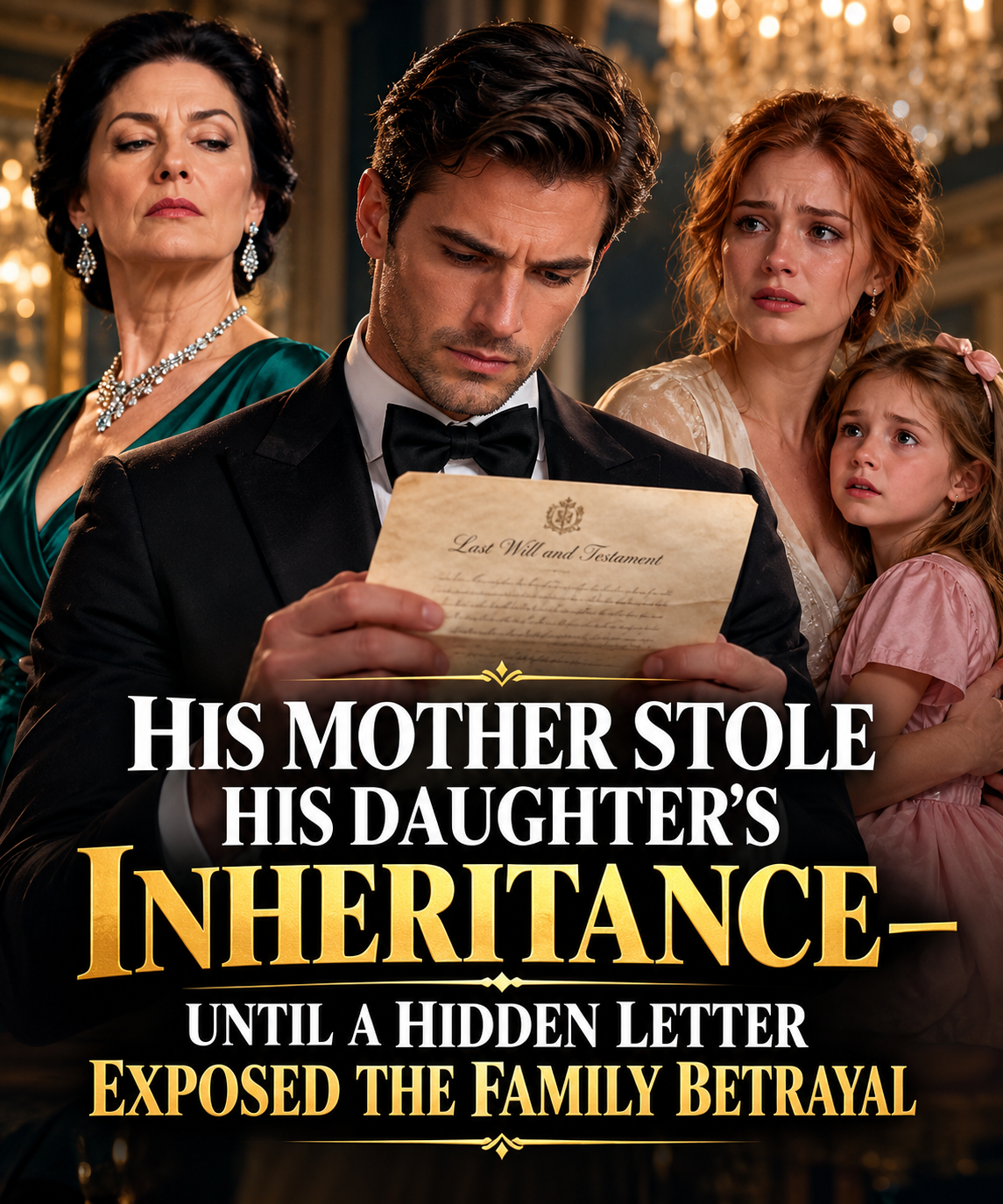
PART 4 — THE FAMILY MATRIARCH’S MOST DANGEROUS LIE
PART 4 SUMMARY: As evidence of financial misconduct surfaces, Victoria prepares to defend herself before the family company’s board. But the confrontation exposes Daniel’s own failures and forces Claire to decide whether she can trust her husband when their daughter’s future is at stake.
Ruth photographed the sale authorization and placed the original in a protective folder. She explained that the notary’s stamp would have to be verified and the signature compared with documents Claire had genuinely signed. Until then, they could not assume the paper had been accepted by a bank or buyer, but they also could not ignore the possibility that someone had used it to move the sale forward. Claire felt exposed in a way she had never experienced before. She had spent years defending herself against Victoria’s accusations, yet now her own signature had been turned into a weapon against her.
Daniel wanted to promise that he would fix everything. The words rose to his throat, but he stopped himself. Promises had helped create this situation. His mother had promised that the money was safe, that the documents were routine, and that Claire’s concerns were unfounded. He had believed her because believing her was easier than admitting the family’s problems might require him to confront the person he loved most.
Ruth arranged for an independent financial auditor to examine the transfers and requested an emergency review of the estate’s proposed sale. She also contacted the family company’s board chair, who agreed to convene a meeting the following morning. By then, Victoria had learned that Daniel was cooperating with the investigation. She responded by circulating a statement to several board members, portraying herself as the person who had kept the company alive during a difficult period. According to her account, Claire was attempting to exploit a technical dispute over an outdated document, while Daniel had personally authorized the disputed financial transactions.
The meeting took place in the company’s conference room, a long space lined with glass walls and framed photographs of the business’s early years. Victoria arrived with her own attorney and a thick binder of documents. She wore a dark tailored suit instead of her emerald gown, but her posture was unchanged. She sat at the head of the table as though the investigation were a minor inconvenience she could dismiss with a sufficiently firm explanation.
When the board chair asked about the missing funds, Victoria did not deny the transfers. She argued that the money had been moved to prevent a subsidiary from defaulting on a major loan. If the lender had seized the subsidiary’s assets, she claimed, the entire company could have suffered. She said the estate’s reputation and hundreds of employees depended on decisions made quickly, without the luxury of lengthy family discussions.
Daniel listened without interrupting. He knew the subsidiary had been struggling, but he had never been told that its losses were severe enough to threaten the larger company. Victoria had presented the problem as a temporary cash-flow issue, not a financial emergency. More troublingly, the records showed that money had passed through accounts she controlled personally before being used for some of the company’s obligations.
“You could have told me the truth,” Daniel said.
“And what would you have done?” Victoria asked. “Stopped every transfer? Called a meeting? Watched the company collapse while you waited for permission?”
“I would have made a decision with the facts.”
“You were not prepared to make that decision.”
The accusation landed harder than Daniel expected because it contained a fragment of truth. He had allowed his mother to handle difficult matters because she had always seemed more confident and experienced. He had signed documents without reading them and treated her assurances as a substitute for his own judgment. But that failure did not give her the right to take money belonging to his daughter.
The independent auditor presented the preliminary findings. Some of the transfers had paid legitimate company debts, but a substantial portion had gone into accounts linked to Victoria’s private financial obligations. The records also showed that the authorization Daniel had signed covered a limited emergency transaction. The amount subsequently withdrawn from the trust was considerably larger, and the original authorization did not establish that he had approved those additional transfers.
Then Ruth presented the disputed sale document bearing Claire’s signature. The notary’s office had no matching appointment record, and the stamp appeared to have been used outside the procedures required by the office. The auditor explained that the document would need further forensic examination, but there was enough evidence to justify suspending the proposed sale while the investigation continued.
Victoria’s expression hardened. “You are all acting as though I stole from strangers. This is my family. I have spent my life protecting what Robert built.”
“Lily is your family too,” Claire said.
Victoria turned toward her. “You think you understand what it takes to keep this family standing? You arrived after everything had already been built. You have no idea what I sacrificed.”
“I know what my daughter lost.”
For the first time, Victoria seemed unable to find a response that would restore her authority. Instead, she turned to Daniel and placed another document in front of him. It was a copy of the authorization he had signed months earlier, accompanied by a declaration stating that he had approved the use of trust funds to support the company.
“You signed it,” Victoria said. “You cannot pretend you were completely uninvolved.”
Daniel examined the document. His signature was genuine, and he could not deny having signed the original authorization. He remembered trusting his mother’s summary without reading the attached pages. He could not honestly claim that he had done everything necessary to protect Lily.
The board chair asked him directly whether he had knowingly approved the use of his daughter’s inheritance.
Daniel hesitated.
Claire watched him, knowing that whatever he said next would affect more than the investigation. It would determine whether their marriage could survive the truth.
Finally, Daniel answered. “I signed a limited authorization because I trusted my mother. I did not knowingly approve the withdrawals from Lily’s trust, but I should have read every page. I will accept responsibility for that failure.”
Victoria looked almost offended by his honesty. She had expected him to defend her, as he had always done, and to allow his own mistakes to shield hers. Instead, he had admitted what he had done while refusing to take responsibility for decisions he had never authorized.
The board chair announced that the proposed sale would be suspended and that the company would place the disputed transactions under independent review. Daniel’s executive authority would be temporarily restricted while the financial investigation proceeded. The trust would also be protected from further withdrawals until the legal status of the codicil was resolved.
The meeting appeared to be ending when the auditor received an urgent call from the bank. He listened, asked several questions, and then turned back toward the table.
“The bank has located the complete transfer record,” he said. “There is evidence that the authorization was altered after Daniel signed it. But the electronic record also identifies the office account used to submit the expanded transaction.”
He paused, looking toward Victoria.
“The account belongs to the person who ordered the transfers.”
Victoria’s face drained of color.
And for the first time, the evidence was no longer merely suspicious.
It was beginning to tell a story she could not control.